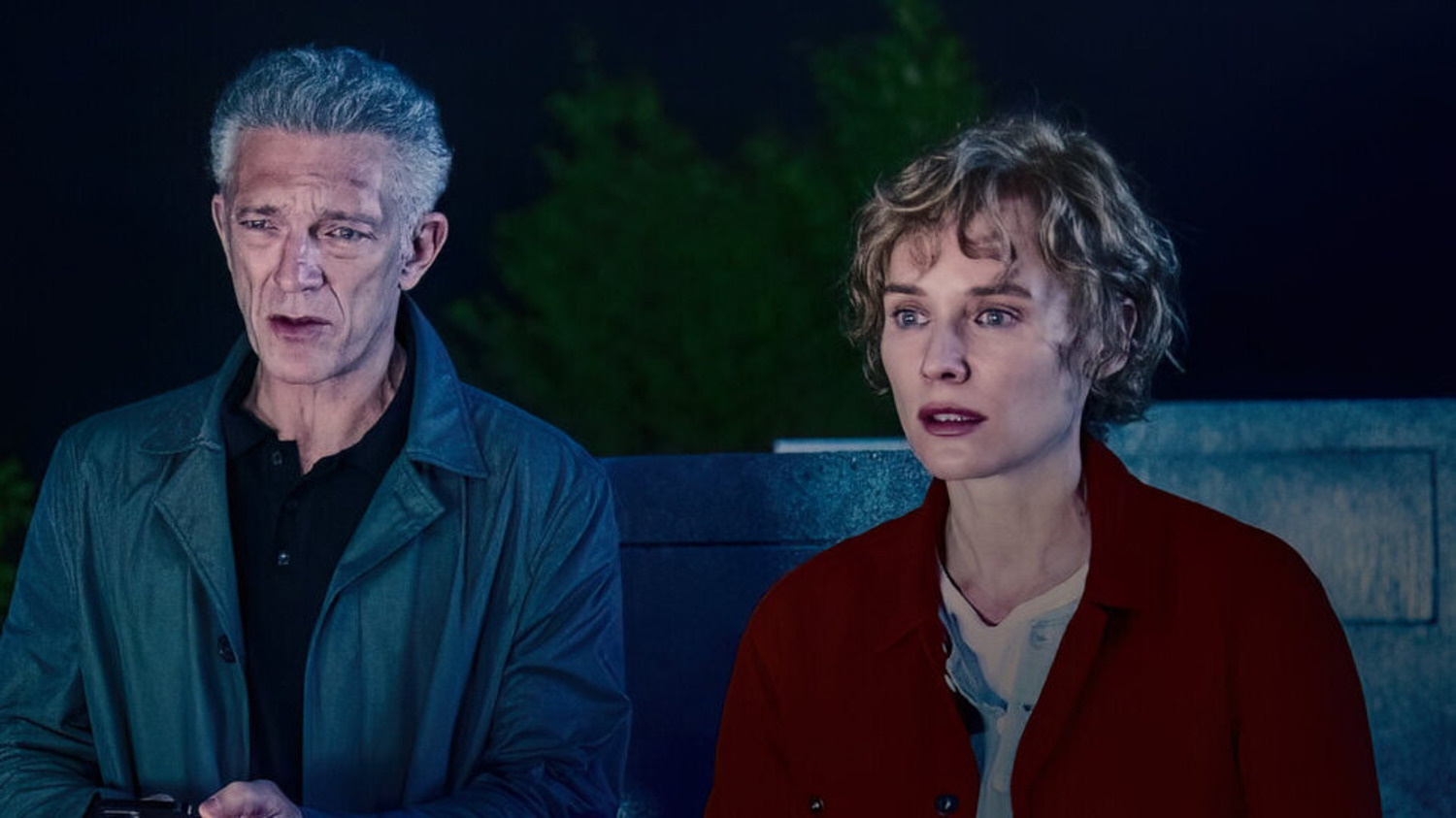
Featured Review
The Shrouds ★★★★★

Released: 4th July 2025
Director: David Cronenberg
Starring: Vincent Cassel, Diane Kruger
You can’t rationalize grief. Sure, there are all the coping mechanisms and futile sympathies, but ultimately the point of the process is to feel less like you’re beside the person you’ve always loved to be next to. It’s interesting how it works; and all the more compelling is to look at how the digital era has essentially rendered grief-altered memories as these fragments of data, bound to be captured by some nebulous storage unit. What once was just a fragile memento found at the bedside table could now be a screensaver, a seemingly permanent photographic replica of a human being who you may no longer be able to touch, hear, smell, or even remember. This is what concerns David Cronenberg with his most recent – and arguably best in almost two decades – effort, The Shrouds.
While many will be eager to jump on the classification wagon, labelling the Canadian director’s latest as a “body horror” film, The Shrouds is far from a traditional Cronenberg feature. Conceived as a response to the director’s tragic loss of his long-time partner who passed away in 2017, this is a work of grand ideas and profound sadness, one that is clever and strangely comforting in dealing with its heavy subject matter. Much like its magnetic leading man in Vincent Cassel’s tech mogul Karsh, it is confused but never confusing, a film that depicts grief in a raw and stupefying manner – the chaotic narrative here very much tries to emulate the confusion that accompanies the process. Couple that with Cronenberg’s vested interest in the rapid adoption of futuristic technology, and what follows is a rumination on the inescapability of digital mourning in an era when privacy has become a commodity.
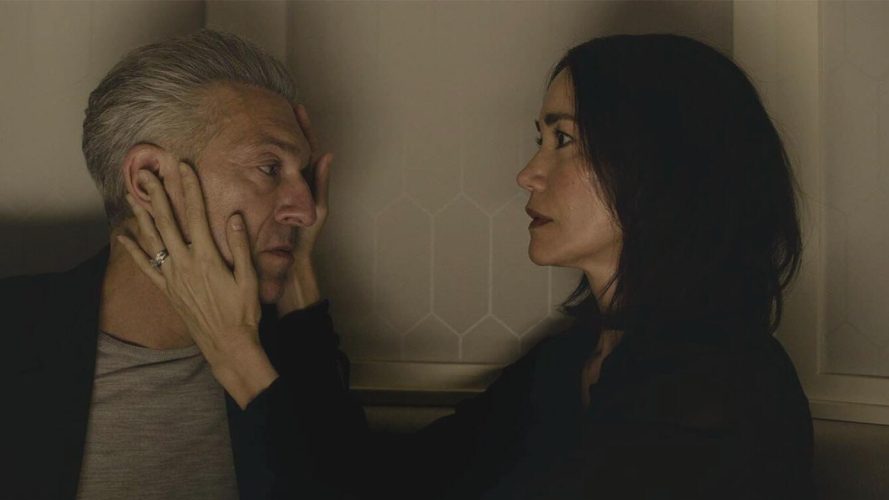
The film opens with Karsh seeing a dentist, who in turn tells him that “grief is rotting [his] teeth”, a response that Karsh seemingly expected to hear. His body is readjusting to a life without his wife, Becca (Diane Kruger), and breaking down as a result of loss. For Karsh, the process of mourning has become second nature, with his business being focused on the creation of the titular “shrouds”: technologically-advanced burial sheets that broadcast live footage of decomposing corpses directly from their graves. It’s morbid, yet Karsh doesn’t seem to mind – he’s fascinated with the tech and finds solace in the digital models. Not unlike Cronenberg, he willingly accepts the promise of an all-digital future in his creations. Karsh wishes for grief to be an integral part of his existence, burying the bodies but leaving them exposed just enough that they don’t slip away as mere memories. Becca’s body isn’t preserved in time: it decomposes, her remains fading into dust, with Karsh being the sole observant of that process in motion. To him, it’s another form of intimacy, one where he takes ownership of Becca’s body for the sake of personal mourning. Curiously, Cronenberg refuses to pass judgment on his lead, as the journey soon descends into conspiracy paranoia and Karsh’s futile attempts at untangling the world where private grief no longer exists.
And yet, we have to embrace that reality. The reality in which the process of grief has become less personal, less intimate, more overtly digitized in the constant pursuit of data collection. On that front, David Cronenberg is one of the few contemporaries who’s able to tackle the subject matter in a way that feels eagerly modern: this is not only him operating at his most vulnerable self, but also navigating the limits of our existence in the increasingly cynical world of boundless connectivity and constant surveillance. It’s clear that the director himself is still working through his own feelings by casting Vincent Cassel as a personal stand-in, an aspect that plays into the matter-of-fact nature of his storytelling here more than anything else. Narrative threads come and go, dreams mesh with reality, characters reveal their ulterior motives hidden beneath some conspiratorial agenda… it’s all a collective delusion, but one you can’t help but try and rationalize. Of course, the only result is going back to square one and realizing this was all an attempt to simply get over it. Could it be that this digitized reality has not only altered grief, but our memories of it too? Not sure if Cronenberg himself has a definitive answer, but he certainly makes a compelling argument to continue living and seeking love – even if it will always remind us of the people we lost.











-

 Featured Review4 weeks ago
London Film Festival 2025 – Hedda ★★★★
-

 Featured Review1 week ago
Predator: Badlands ★★★★
-
 Interviews4 weeks ago
Don Worley on Second Chances, Making Movies and Stand-Up Stages
-

 Featured Review4 weeks ago
London Film Festival 2025 – High Wire ★★★★
-

 Featured Review4 weeks ago
London Film Festival 2025 – Frankenstein ★★★★★
-

 Movie Reviews3 weeks ago
London Film Festival 2025 – Left-Handed Girl ★★★★
-
 Featured Review3 weeks ago
London Film Festival 2025 – Die My Love ★★★★
-

 Movie Reviews3 weeks ago
London Film Festival 2025 – The Chronology Of Water ★★★