Featured Review
Dying ★★★★★

Released: 25th July 2025
Director: Matthias Glasner
Cast: Lars Eidinger, Corrina Harfouch, Lilith Stangenberg, Hans-Uwe Bauer
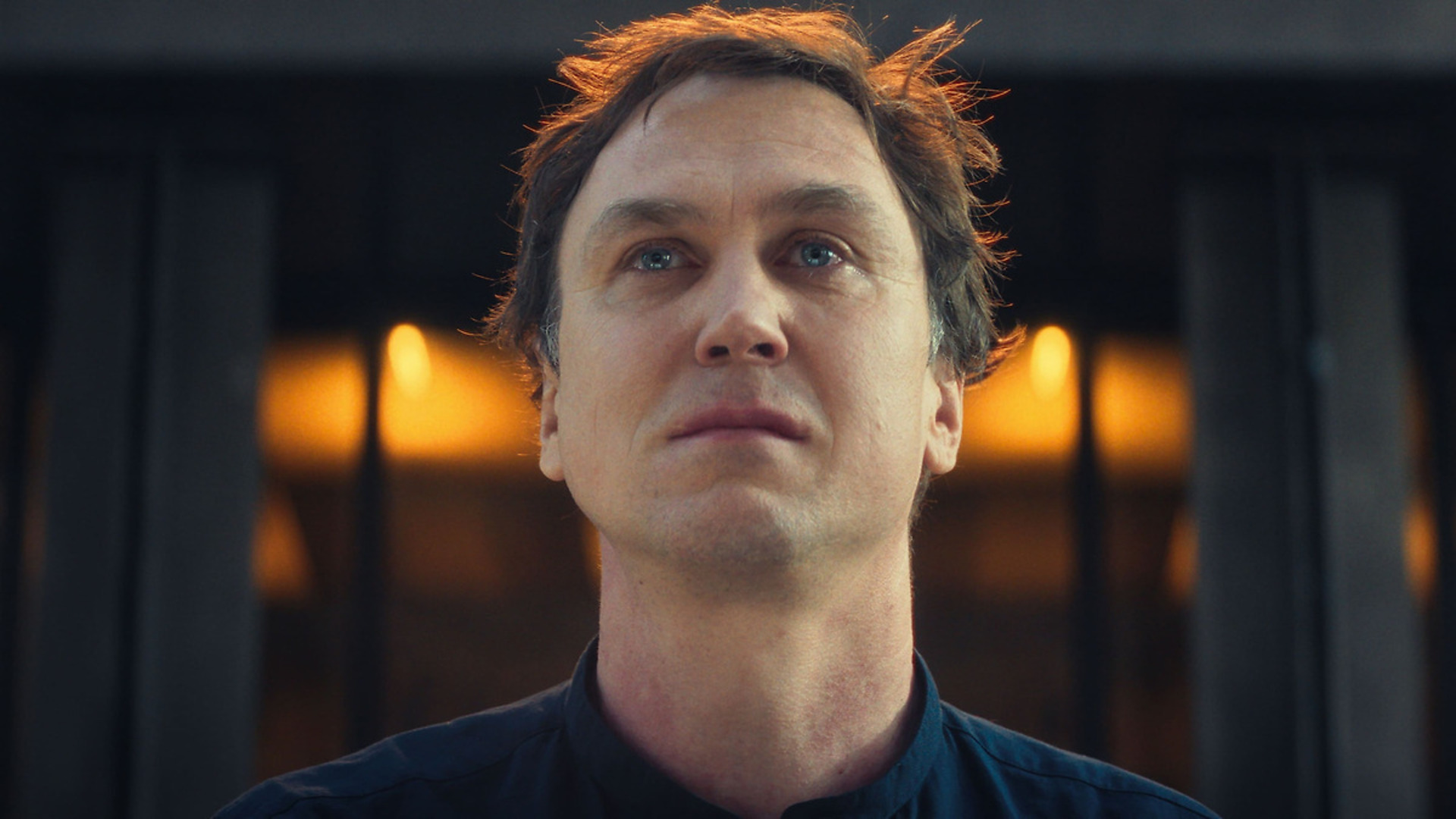
As the title suggests, Matthias Glasner’s evocative and complex comedy drama is all about death. Mortality is an overriding factor in all of the character’s lives, from the elderly couple Lissy (Corinna Harfouch) and Gerd Lunies (Hans-Uwe Bauer) to their two adult children, Tom (Lars Eidinger) and Ellen (Lilith Stangenberg). Impressively, Glasner adds stinging comedy to the mix too, slotting in neatly (somehow) with the emotional drama of Dying (Sterben), and working together to form one of the year’s best dramas. There is a looseness to it that can be distracting, but numerous firecracker set-pieces of intense emotional drama and an overarching loneliness ensure Dying is as striking as it can be.
Dying is split into a number of chapters, some titled simply by the character’s names, others by more abstract means such as “The Thin Line” or “Leben (Living)”. Its first segment is about Lissy, who we first meet sitting on the floor of her apartment in her own faeces. Declining mobility issues and other health problems make this a common occurrence, and the suffering is compounded when her neighbour, Susanne (Catherine Stoyan), brings back Lissy’s husband Gerd, who lives with dementia . Dressed only in a shirt and nude from the waist down, he frequently wanders into other homes like this.
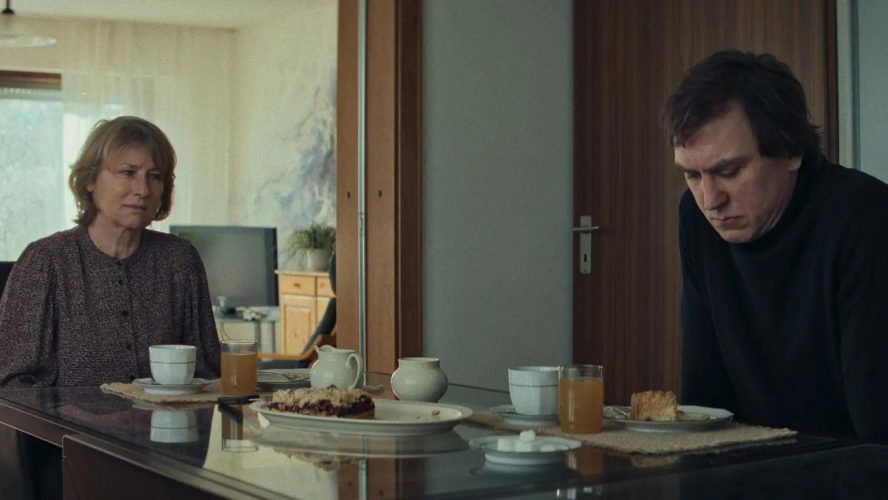
What might become quite a formulaic procession of a family drama instead builds into something magnificent, epic, and hugely unpredictable. The Lunies aren’t your average family, and over the course of the next three hours in Dying, Glasner scales highs and lows of their journey that you frequently don’t expect. Lissy’s relationship with Tom is particularly fascinating, coming to a head midway through the film in an unforgettable scene where they essentially tell each other they do not love one another, and never have. There is a coldness to both characters, but it makes it no less heartbreaking to watch.
The disconnect between some scenes and chapters in Dying is there for a reason, reflective of the Lunies family and their lack of connection. In particular, Ellen, a dental assistant with an alcohol problem, shares few scenes with her family, effectively showing their vast distance more than any lengthy scenes might. Her story, in which she begins a romance with colleague Bernard (Robert Gwisdek), is the saddest, her alcoholism giving her initial freedom before it inevitably takes everything away from her.
Tom is very much at the centre of Dying, as the film builds up to his conduction of an orchestral project called Dying by his friend, Sebastian (Ronald Zehrfeld). Here the comparisons to Tár are obvious, and like that film, Dying brilliantly utilises music to create impactful emotional responses. Two of these moments are lengthy highlights of the film. A late dialogue-heavy scene with Bernard is also an unforgettable moment, as are the parts that follow soon after.
On the whole, the acting throughout Dying is world-class. From Eidinger’s cold, methodical way he brings Tom to life, to Stangenberg’s dynamic and spiky energy that she slams out of Ellen, every actor is on top form here, bringing realism and tangible life to Glasner’s magnificent and detailed screenplay. It’s a script that can be as depressing as hell on many occasions, but even in some of these darkest moments, there is absurdity and humour to be found. Both death and life hang over everything in Dying, but perhaps most strikingly, it’s the pervading loneliness that mists every character’s lives that is most haunting.











-

 Featured Review4 weeks ago
London Film Festival 2025 – Hedda ★★★★
-

 Featured Review1 week ago
Predator: Badlands ★★★★
-

 Interviews4 weeks ago
Don Worley on Second Chances, Making Movies and Stand-Up Stages
-

 Featured Review4 weeks ago
London Film Festival 2025 – High Wire ★★★★
-

 Featured Review4 weeks ago
London Film Festival 2025 – Frankenstein ★★★★★
-

 Movie Reviews3 weeks ago
London Film Festival 2025 – Left-Handed Girl ★★★★
-
 Featured Review3 weeks ago
London Film Festival 2025 – Die My Love ★★★★
-
 Movie Reviews3 weeks ago
London Film Festival 2025 – The Chronology Of Water ★★★