Movie Reviews
Tron Ares ★★

Released: 10th October 2025
Director: Joachim Rønning
Starring: Jared Leto, Greta Lee, Jodie Turner-Smith, Evan Peters, Gillian Anderson, Cameron Monaghan, Arturo Castro, Hasan Minhaj & Jeff Bridges
If you asked any sci-fi fan about the influences that connected them to the genre, I’m sure many would say the following – Star Wars, Star Trek, Blade Runner and Dune, to name a few. Few – such as myself – will also include Steven Lisberger’s Tron.
Lisberger’s film holds a special place in my heart, a goosebump core memory of seeing something I’ve never seen before as a child. Sure, the visual effects are dated (it was the 80s, okay, don’t sweat it), but it also felt revolutionary, like watching being on the cusp of an innovative future. Fast forward to 2010, and Joseph Kosinski’s Tron Legacy entered the digital chat as a worthy upgrade, a PlayStation glow-up of sleek visuals, neon-lit black suits and a Daft Punk score that was one for the ages. It also had Michael Sheen Zeus, living his best program life as an eccentric, David Bowie inspired Zeus, because why not? For a franchise that introduced audiences to the grid, lightcycles and life beneath the binary ones and zeroes, who says this franchise doesn’t know when to have fun?
Revisiting the franchise leading up to Joachim Rønning’s Tron Ares, comes at the awareness of how much of our technological world has changed. In the space of 43 years since Tron’s debut, we’ve gone from learning lines of coded commands to having everything conveniently at a ‘tap’ of an app. Now with the acceleration of AI, deepfakes, cyberhacking and internet bots, technology’s accessibility has evolved into something darker, meaner and menacing. In encompassing that tone, if Daft Punk’s Tron Legacy score came with a sense of digital wonder and possibilities, then Nine Inch Nails is the moodier and grungier upgrade. Yet despite the brilliance of NIN’s intense score (the best thing Rønning’s film has to offer), mood and vibes are simply not enough to carry the weight of what Tron Ares presents in this disappointing sequel.
There’s a certain irony to Tron Ares’ AI-infused premise. Rønning’s soft reboot comes across as a pale imitation of its predecessors, unable to infuse Tron’s nostalgic past and what it presents as its future. The innovation that the franchise once possessed, feels strangely stale, cold and absent, content to repeat and generically repackage what has been trailblazed before rather than chart something groundbreaking and unique.
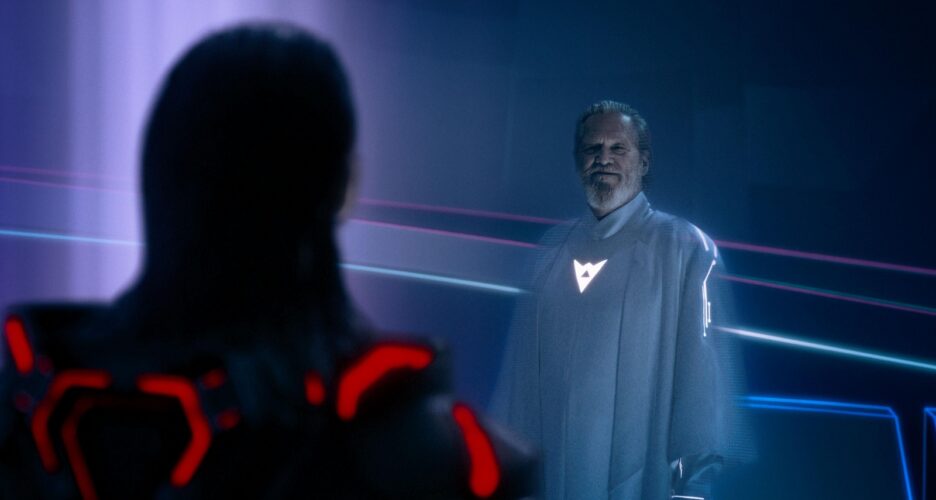
The feeling is not helped by the superficialness that surrounds Jesse Wigutow’s screenplay. Sure, the script evolves Tron’s technological concept, swapping the grid for the real world but it revels in the bare bones of it all. A tale of two warring companies in ENCOM (led by Greta Lee’s Eve Kim) and Dillinger Systems (led by Evan Peters Julian Dillinger) competing for the digital frontier that Kevin Flynn (Jeff Bridges) once prophesied. It takes on the form of the prominence code, the mechanism for which digital life can sustain itself outside of the grid (or as the film states, lasting more than 29 minutes of its lifecycle in humanity’s first contact with artificial intelligence beings). In playing God, Julian creates Ares (Jared Leto), an AI super soldier who begins to rebel against his original programming, and thus bringing forward its technological battleground into the real world.
Now Tron’s worldbuilding logic has always played ‘fast and loose’ to explain its mythology (e.g. growing digital food for human consumption). Yet, it comes with the territory, a good faith exercise the franchise elicits of imagined realities that haven’t been realised – yet. They go beyond the frequent conversations of the franchise being rooted in a style over substance, that’s until Ares positions itself as the one that doesn’t advance the argument at all.
The film’s lack of engagement and blanket statements of “uplifting humanity” through AI doesn’t seem to know what argument it wants to make about its latest installment. The AI conversation is safely wrapped in its digital entanglements, anything from pro-military weaponry to climate change, but with no real emphasis on its moral implications, safety or what it truly means to rebel against your code or its implications for humanity. Instead, Rønning crafts “scenes”- scenes of coolness, scenes which resemble music video interludes, scenes with a ‘wink and nod’ nostalgia, rushed scenes and horribly-placed slow-mo scenes – all before light cycling its way back to something resembling a movie. Even switching from the ecosystem of the grid for the downtown streets of Vancouver robs it of its original charm and magic, treating the events like a localised outbreak rather than a colossal change. Similar to the justification of Jurassic World Rebirth, these motions exist because studios decided it can, uninspired blockbusters that have modelled itself on this same ‘copy and paste’ architecture, which doesn’t bode well for future filmmaking.
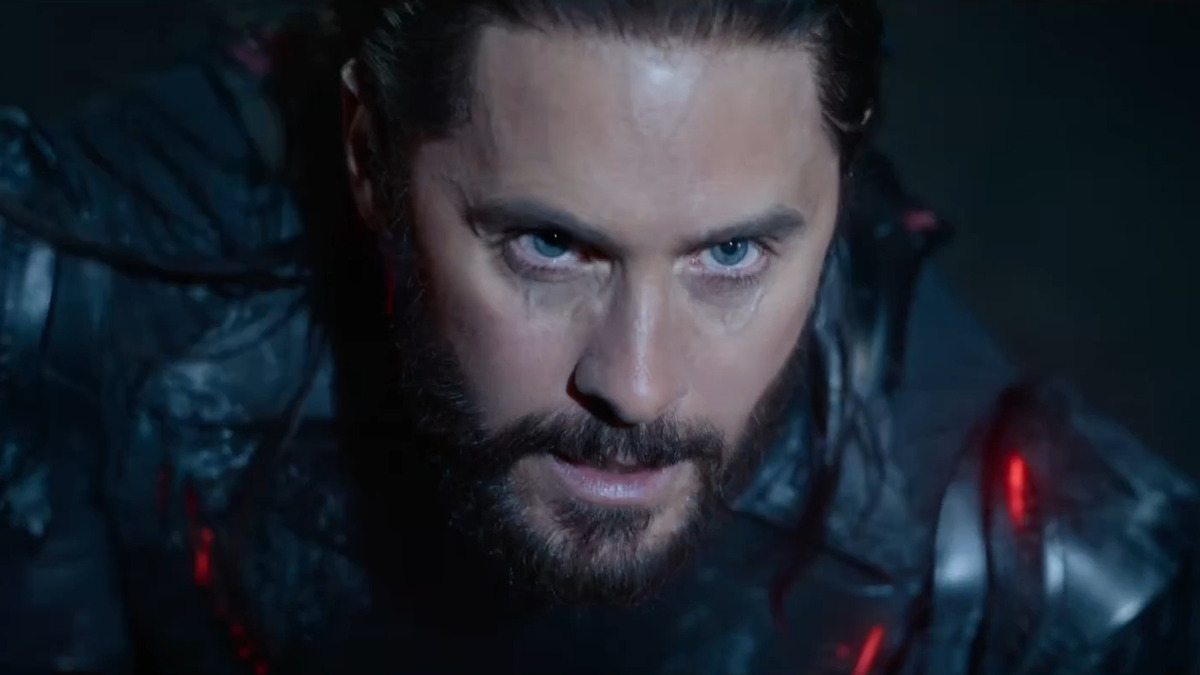
And in telling this story, the film hinges its faith on the least fascinating element with Leto’s Ares. Caught between the digital fight of corporate interests (which is not as remotely interesting as Legacy’s father/son storyline), Wigutow’s screenplay at least attempts to ask pertinent questions about a digital life on whether an artificial program can “feel”, both emotionally or the values we imprint on such creations. The way Julian Dillinger refers to Ares as an “expendable” is evidence of that, making the super soldier’s inevitable transition predictably easy to follow. But there’s no spark in Leto’s performance – he remains monotone and robotic throughout, meaning frequently disconnecting with his character.
The rest of the cast are given the bare minimum of characterisation, but the better elements of Ares lay with Eve and Jodie Turner Smith’s Athena. With Eve, the emotion comes from the death of her sister, following in her footsteps to complete her work and honour her. Turner Smith has the most fun, a program who believes in the system for which she was created, only to feel betrayed by Ares’ rebellion. It’s the closest you get to feeling something for a digital creation, and seeing Smith turn on the intense gears, is at least, worth engaging with.
Too much time has passed for Tron Ares to capitalise on the hyped momentum that was set 15 years ago with Legacy and 43 years after Lisberger’s film, and it doesn’t seem to have an answer for what Tron means for the here and now generation. That’s not “bio-digital jazz man,”, that’s just sad and unsatisfying for a film that wasn’t worth the wait. Time for the franchise to search for a new source code to write and inject some new ideas. End of line.














-

 Featured Review4 weeks ago
London Film Festival 2025 – Hedda ★★★★
-

 Featured Review1 week ago
Predator: Badlands ★★★★
-

 Interviews4 weeks ago
Don Worley on Second Chances, Making Movies and Stand-Up Stages
-

 Featured Review4 weeks ago
London Film Festival 2025 – High Wire ★★★★
-

 Featured Review4 weeks ago
London Film Festival 2025 – Frankenstein ★★★★★
-

 Movie Reviews3 weeks ago
London Film Festival 2025 – Left-Handed Girl ★★★★
-

 Featured Review3 weeks ago
London Film Festival 2025 – Die My Love ★★★★
-

 Movie Reviews3 weeks ago
London Film Festival 2025 – The Chronology Of Water ★★★